| Wii | |

| |
| Release Date | 🇺🇸 NA: November 19th, 2006 🇯🇵 JPN: December 2nd, 2006 🇦🇺 AUS: December 7th, 2006 🇪🇺 EU: December 8th, 2006 |
| Status | Discontinued |
| Manufacturer | 
|
| Type | Home Console |
| Drawn to Life Games | 
|
Predecessor
|
Successor
|
–Official Nintendo Wii slogan
The Wii is a home video game console developed by Nintendo, notable for it's inclusion of motion controls via the controller, known as the Wii Remote or Wiimote. It first released in 2006 and went on to become the best-selling home console of the seventh generation, despite being the least powerful. Just one Drawn to Life game ever released for it, which was criticized for the use of the Wiimote's IR pointer to draw, but was praised in other aspects.
 HistoryEdit
Early DevelopmentEdit
Conceptual development on Nintendo's seventh-generation console began in 2001, the same year its predecessor the GameCube released. Initially codenamed "GameCube Next" and eventually "Nintendo Revolution", Nintendo aimed not to expand their reach with the system power-wise, but gameplay-wise. When Satoru Iwata became Nintendo CEO in 2002, he expressed a desire to venture into markets Nintendo hasn't been as successful in. He directed Genyo Takeda to form a more accessible marketing strategy in 2003, targeting a more casual gaming audience. The system's famous motion controls were born as a result of a partnership between Nintendo and Gyration Inc., a manufacturer of wireless computer mice who had motion-sensing patents in place. Other prioritized features decided early on include online gaming via Nintendo Wi-Fi Connection (WFC) and backwards compatibility with the GameCube, with the latter feature resulting in a similar GPU level.
The system - given it's final name the Wii in April 2006 - was officially released on November 19th of that year in North America, with the Japanese and PAL launches occurring the following December. Nintendo's effective marketing campaign resulted in the system becoming a monumental success almost instantly, eventually becoming the best-selling console of its generation at 101.63M shipped units. Much like their handheld of that era, the Nintendo DS, the Wii was seen as a revolution for its controls, accessibility and unique gameplay opportunities. While many of the first- and third-party titles released for the system were acclaimed, the primary focus on more casual audiences resulted in many developers choosing to produce lesser-quality work en masse, commonly regarded as shovelware. That didn't prevent the system from having a long-lasting life, however; while succeeded by the Wii U in 2012 and discontinued in the following year, it kept getting new games in development until the release of Shakedown: Hawaii in 2020.
Development of Drawn to Life: The Next ChapterEdit
With Drawn to Life being released to great success, THQ envisioned expansions for the series going forward, beginning with the series' sole licensed title. They initially wanted 5th Cell to develop an entry for the Wii, but the team was very selective on expansions, choosing to prioritize scale and sensibility over producing half-baked tie-ins.[1] They gave their blessing on a Wii entry being developed regardless, which led to THQ shopping for development teams to make it. Ultimately, Planet Moon Studios was decided, with the title being given the same name as its DS counterpart. According to production notes given out by Ken Capelli, production started with the first milestone build in February 2008 and concluded in August 2009, resulting in a total development time of just over 18 months, and had a final budget of $4,465,147.
Much like the rest of the series, development crunch proved to be a major issue; Planet Moon had enlisted their B-team to produce it as a safety production while the A-team worked on another project, the cancelled Xbox 360 game My Amazing Story. The team checked back on the game's production once the latter winded down, and the B-team had been struggling to keep production afloat. It was in such a rough state that the A-team had to step in and assist in finishing the game.
–Ken Capelli
Both versions of The Next Chapter were announced on the same day, May 26th, 2009, and would see release on October 8th. Critics were more mixed on the game compared to the DS version, with many criticising the Wiimote's pointer controls in Draw Mode and the story not being considered as strong. On the other hand, the visual style, gameplay mechanics and overall expansion of the Draw Mode were praised. This version would be the better-selling of the two, and was even considered canon by 5th Cell themselves, although this canonicity has since been removed. The Wiimote's finicky controls within this game would end up inspiring the uDraw GameTablet, an accessory that first released on the Wii in 2010 and a known contributing factor to THQ's closure.
 Notable GamesEdit
| Game | Developer | Publisher | Release Date |
|---|---|---|---|
 |
 |
|
Nov. 19, 2006 |
 |
|
|
Nov. 19, 2006 |
 |
  |
|
Dec. 2, 2006 |
 |
  |
 |
Oct. 23, 2007 |
 |
|
|
Nov. 1, 2007 |
 |
 |
|
Jan. 31, 2008 |
 |
|
|
Apr. 10, 2008 |
 |
 |
|
May 18, 2009 |
 |
|
|
Jun. 25, 2009 |
 |
 |
|
Oct. 8, 2009 |
 |
 |
|
Oct. 26, 2009 |
 |
|
|
May 23, 2010 |
 |
 |
|
Jun. 10, 2010 |
 |
 |
|
Nov. 14, 2010 |
 |
 |
|
Nov. 14, 2010 |
 |
 / / |
 |
Apr. 12, 2011 |
 |
TNX |
|
Jul. 21, 2011 |
 |
 |
|
Oct. 24, 2011 |
 |
|
|
Jul. 19, 2012 |
 |
 |
Self-Published | Jul. 9, 2020 |
TriviaEdit
- The uDraw was also intended for more licensed Drawn to Life series games in the vein of Drawn to Life: SpongeBob SquarePants Edition[2], but no other games in that caliber were ever developed.
- All three variations of the Wii are compatible with Drawn to Life: The Next Chapter (Wii).
- With only one entry under it's belt, the Wii is among the systems with the least amount of Drawn to Life games.
 MediaEdit


The original Wii model.

The Wii Family Edition.
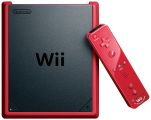
The Wii Mini.


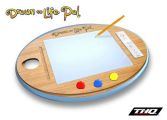
Initial concept art of the uDraw GameTablet by Daniel McGuffey, titled Drawn to Life Pal during development.

Updated mockup of the Drawn to Life Pal, with a closer resemblence to the final uDraw GameTablet design.
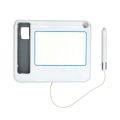
The uDraw GameTablet, released in 2010.

The upgraded uDraw, released in 2011.


Note: This section will mainly show Drawn to Life-related assets.

Drawn to Life: The Next Chapter (Wii) cover
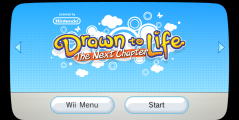
Wii Menu Banner
Wii Menu Channel

Wii safety notice message.

Ditto, this one instructing players to wear the wrist strap.


 ReferencesEdit

Additional InfoEdit
- Wii page on Wikipedia